A measuring tool does not have to be the most expensive one in the cabinet to earn its place. It does need to be accurate enough for the job, easy to read, and solid enough to hold its setting. Those are the things I wanted to check with this batch of PEC measuring and layout tools.
First, a little disclosure: I became a PEC distributor because I already owned some of their tools, liked them, and found them surprisingly difficult to buy. PEC is a California company. Some of its products are made in the United States, although the solid squares I unpacked here were not. My attitude is pretty simple: if the tool is good, it is good.
I left these tools in their packaging so I could examine them fresh, rather than handpick examples that I already knew would behave. The results were encouraging, with one important reminder about checking combination squares.
The prices below are the prices quoted at the time of this original unboxing, not current prices. They are useful for understanding why these tools caught my attention.
Key Takeaways
- The PEC solid squares compared within one thousandth of an inch of my Starrett reference.
- Combination squares deserve accuracy checks, including tools already established in your cabinet.
- Divider size, secure locks, and readable scales matter as much as a tool’s finish.
- Choose steel-rule graduations that match the fractions you actually use in the shop.
Solid Steel Squares: An $80 Tool Against a $700 Reference
The first comparison was between a 12-inch PEC solid steel square priced at $80 and my 12-inch Starrett, which we priced at about $700. That is quite a difference. The obvious question is what you give up.
I brought the squares together with their stocks seated firmly, checked the contact surfaces, and looked for light between the blades. I also used a 0.001-inch feeler gauge to investigate any gap.
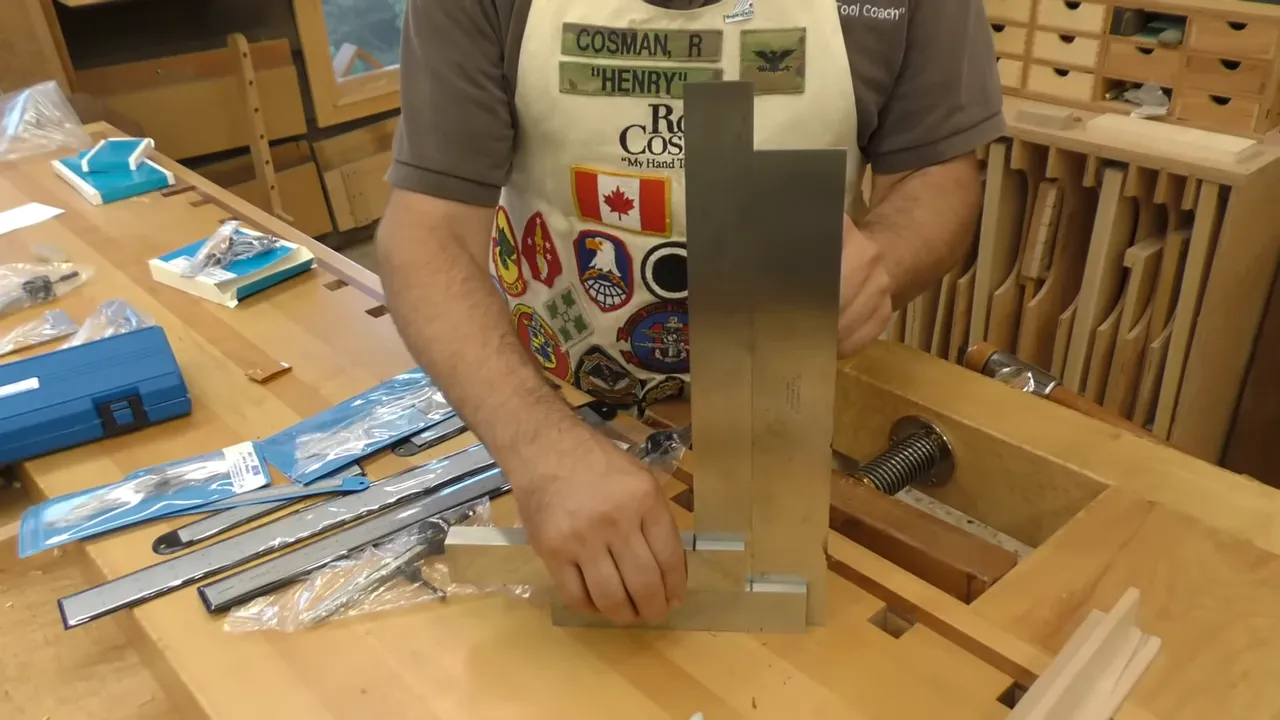
With the 12-inch PEC, I could just make out a little light, but I could not measure the gap with that gauge. In this comparison, the difference was less than one thousandth of an inch. For an $80 square, I thought that was very good.
There is an important qualification: this assumes my Starrett reference is right. This was a practical shop comparison, not an independent laboratory certification.
What Was Different About the Construction?
The PEC blade was narrower than the Starrett blade, but its stock was approximately half an inch longer. Measuring the PEC overall gave me about 8 1/4 inches across the stock and 13 5/8 inches in height. The narrower blade was the most obvious physical difference, rather than any measurable problem in that initial squareness check.
While the reference square was out, I checked the smaller PEC squares as well:
- 6-inch solid square, $20: the comparison again showed less than a 0.001-inch gap.
- 4-inch solid square, $17: I could not detect a gap with the 0.001-inch gauge.
Those are very attractive prices for the results I got. A set of four smaller solid squares was also on my intended stocking list, but it was backordered, so I could not unpack that set with the rest.
The 6-Inch Combination Square: Fit, Finish, and a Firm Lock
I already had PEC combination squares in my tools, including ones that traveled with me. This new 6-inch combination square was priced at $70 and was the hardened version, rather than the cast-iron version PEC also offered.
The first thing I checked was the lock. A combination square that slides when it should stay put is irritating, no matter whose name is on it.
I have two small Starrett combination squares. One locks properly; the other has a problem that keeps it from staying tight. In fairness to Starrett, I had never contacted them to ask for a replacement. That is a problem with that particular tool, not a reason to dismiss the brand.
The PEC locked up firmly. Its fit and finish looked good, and the graduations were easy to see. In fact, I found its rule easier to read than my older Starrett, although comparing a new tool with one I have used for years is not entirely fair.
The head also included a bubble level and a small stored scriber. The scriber stayed in place with enough friction to keep it from falling out.
My one preference went to the Starrett bubble level. I found it easier to see than the green vial in the PEC. With my eyes, that matters. A tool can be nicely made and still lose a point if I have to struggle to read it.
My first impression of the little PEC was positive: a solid lock, a readable rule, and a nicely finished head.
The 12-Inch Combination Set: Check Accuracy Before Trusting It
The 12-inch hardened combination square came as a three-piece set in a sturdy fitted case. Its price was $116, distinct from the $80 price of the 12-inch solid square.
Assembly was straightforward once the locking piece was aligned with the groove in the rule. The graduations were clear, and the fine thread on the locking mechanism made it easy to tighten. The knurled nut gave a good grip. The larger bubble level was also easier for me to see than the one in the small head.
Then I checked it against the solid reference square.
This time there was a visible gap. After sorting through the feeler gauges and correcting my initial readings, the gap caught a 0.006-inch gauge. For perspective, I use about 0.004 inch as the thickness of an ordinary sheet of writing paper. So this was not the same result as the solid PEC squares.
The useful part is that this style of combination-square head can be corrected at its internal bearing surfaces. But first, you have to establish exactly where it is wrong.
How I Would Correct the Combination-Square Head
In this particular case, the blade touched near the top of the comparison but not at the bottom. That told me which contact surface needed attention.
- Clean and check the contact surfaces. Make sure nothing is trapped between the tools before diagnosing an error.
- Determine the direction of the error. Identify where the blade touches the reference and where the gap opens.
- Remove the rule from the head. Look inside the slot to find the small raised bearing surfaces that support it.
- Remove a tiny amount from the appropriate bearing surface. For the error I found, I would work on the top edge of the internal tooth I identified.
- Reassemble, lock, and check again. Repeat gradually until the comparison is right.
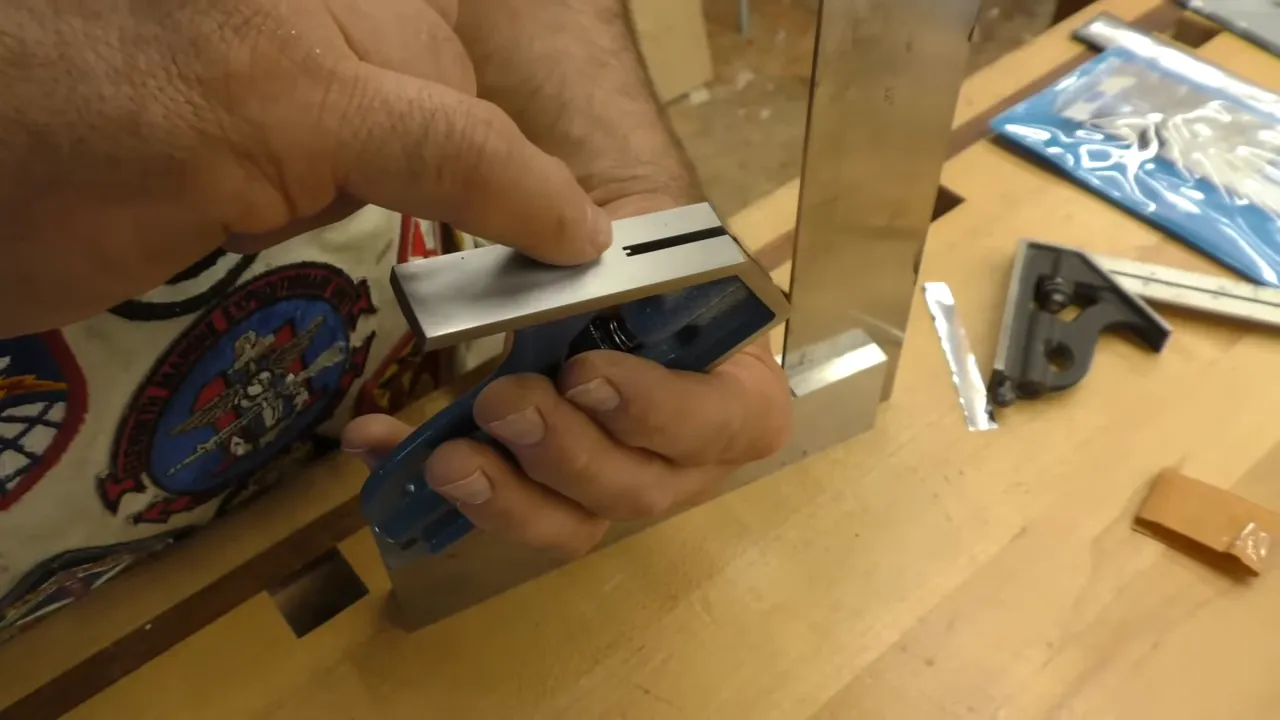
Access is narrow. A regular file might not fit, but I had a small diamond file that could reach the edge. The key is to take off very little, then check again. I explained the correction here; I did not complete and verify the adjustment during this unboxing.
An Existing Square Needed Attention Too
For comparison, I pulled another combination square from my cabinet. I initially mistook it for a Starrett, but it was actually a Pinnacle. That one was out as much as, if not more than, the new PEC.
That was a useful surprise. I had not checked it this closely before, and it needed adjustment too.
Do not assume a combination square is accurate just because it is familiar, expensive, or already in your cabinet. I put more confidence in a good solid steel square as a reference than in a sliding assembly. The adjustable tool is useful, but its accuracy deserves checking.
Square-Leg Dividers: Substantial Tools at Sensible Prices
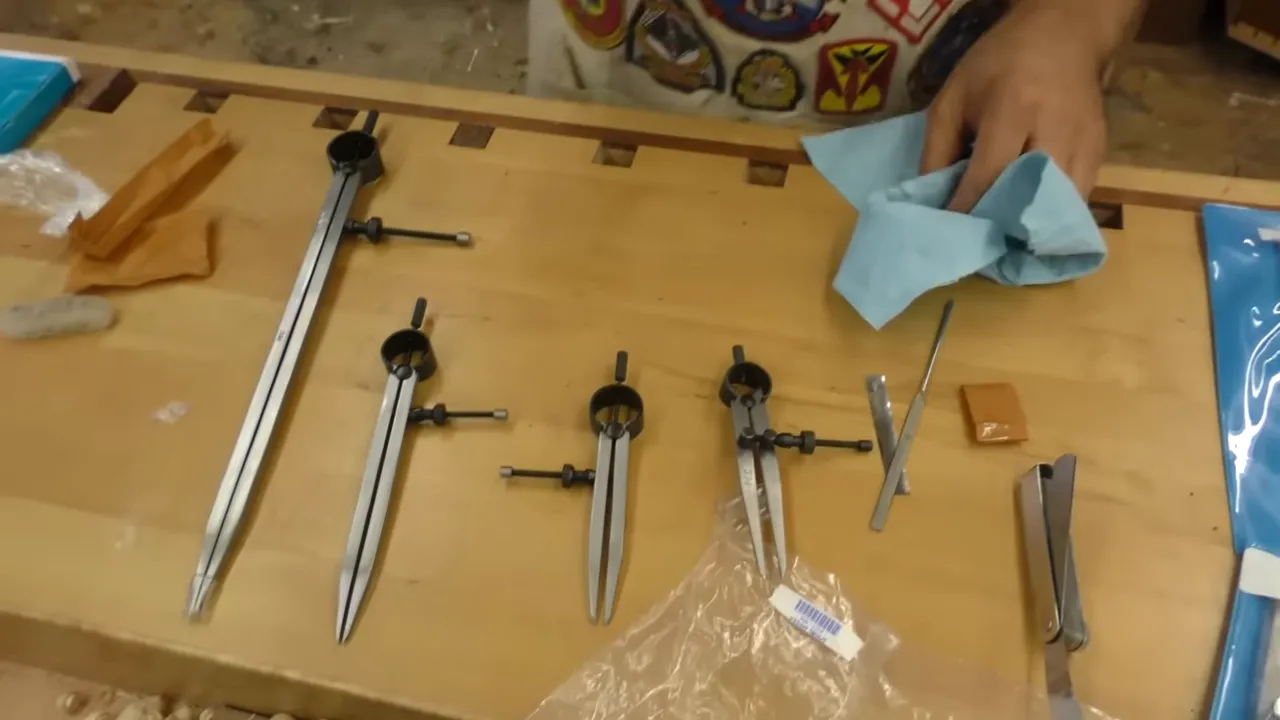
The dividers were another pleasant part of the batch. I had previously bought a little 3-inch pair that felt rather flimsy. These square-leg versions were much more substantial.
The prices quoted were:
- 4-inch dividers: $13.
- 6-inch dividers: $13.
- 12-inch dividers: $25.
For comparison, the Starrett square-leg dividers we discussed were around $130 to $140. I would still give the Starretts the edge in overall quality, but these PEC dividers offered a lot for the money.
Why the Speed Nut Helps
These dividers use a split speed nut. When disengaged, it lets you make a large change in opening without winding the nut along the entire thread. As its tapered portion seats into the matching cone, the split nut closes and engages the screw for fine adjustment.
That makes it quick to move from one setting to another. I found the quick movement easier than on my own Starrett dividers.
The legs were good and heavy, and the tips were proper points. That last detail is worth checking. On some cheap dividers, the ends are closer to little knife edges than true points. These looked like points I could work with.
Choose the Size for the Work
For laying out dovetails, the 4-inch dividers would be my choice. The 6-inch pair felt unnecessarily large for that job.
The 12-inch dividers are for those occasions when a small pair simply will not reach. I seem to find myself wanting that extra capacity often enough, and these had good points and a straightforward adjustment mechanism. They were headed into my cabinet. Then, of course, comes the usual problem: finding room for another tool.
The Sliding T-Bevel: Nicely Machined and Secure
I also tried a PEC sliding T-bevel. The parts looked well machined, and the blade locked quite firmly.
My immediate impression was that it worked better than the wooden-bodied bevel I had been using. A bevel needs to move when you are setting it and stay put once you have tightened it. This one gave me a good first impression on both counts.
I did not have its price on hand, so I will not invent one. It was another tool I was happy to make space for.
The Protractor: Readability Is a Practical Feature
I use a protractor fairly often, and two things matter to me: I need to read the scale, and I need the blade to stay where I set it.
One of my existing protractors no longer locked properly. Trying to use a tool while the blade slips around is an aggravation I can do without.
The PEC stayed put, looked nicely made, and had a scale that stood out much more clearly than the older example I put beside it. Especially with my eyesight, that difference was substantial.
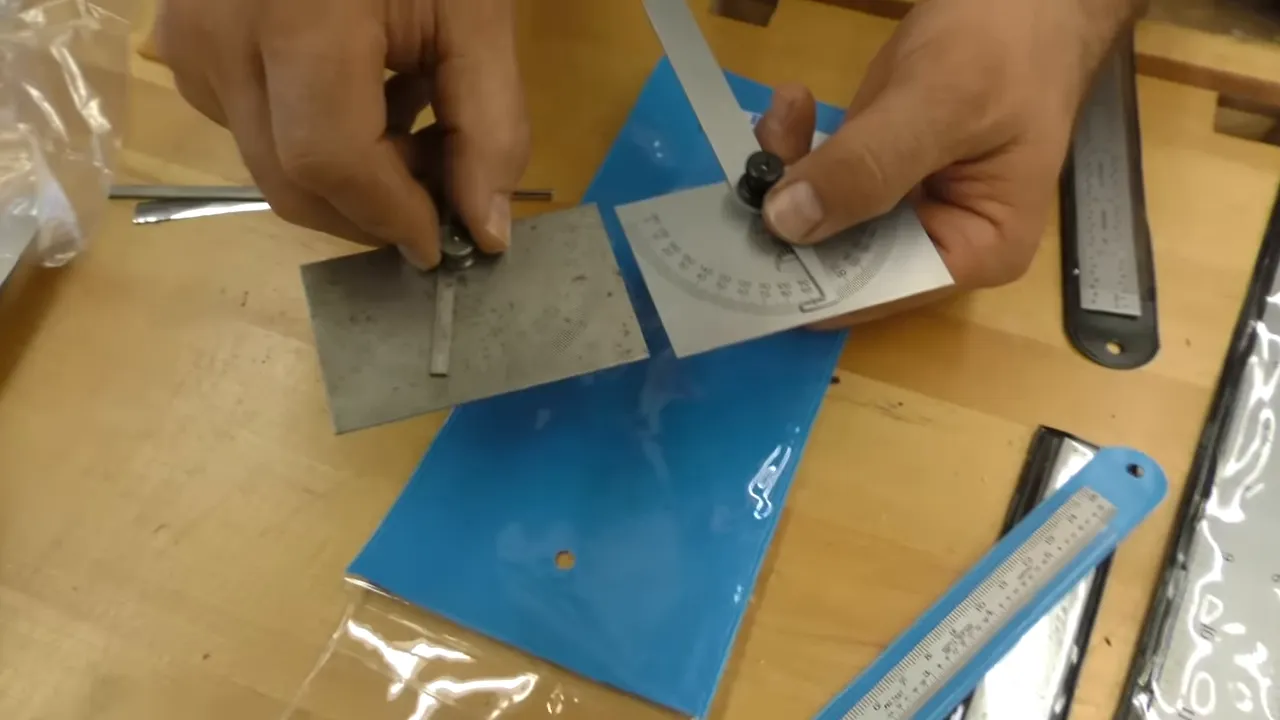
Fine graduations are not much help if you cannot distinguish them. Readability belongs on the buying checklist alongside machining and locking action.
Steel Rules: Buy the Graduations You Actually Use
One complaint I had about an earlier PEC rule turned out to be my own ordering mistake.
I had bought a rule with tenths, fiftieths, and hundredths on one face, and thirty-seconds and sixty-fourths on the other. There was nothing inherently wrong with that arrangement, but I normally work in sixteenths or thirty-seconds. It was the wrong choice for me.
The rules I selected to stock used:
- 1/8-inch graduations.
- 1/16-inch graduations.
- 1/32-inch graduations.
- 1/64-inch graduations.
That arrangement appeared on the longer rule, the 12-inch rule, and the little 6-inch rule. All were easy to read.
Check the graduation pattern before ordering a steel rule. Length is only part of the specification. A good rule with the wrong divisions can be a nuisance every time you pick it up.
Thin, Flexible Rules for Sharpening
I also brought in some thin, flexible steel rules specifically for sharpening. They were smooth, with a suitable smooth face for the blade to travel over rather than producing that buzzing feel across graduations.
They were thinner and more flexible than the rules we normally used. That was a separate reason for selecting them, rather than simply treating every 6-inch rule as interchangeable.
Calibration Certificates: A Welcome Detail in the Packaging
Before finishing, I noticed calibration certificates tucked into the backs of the steel-rule packaging. That was a nice detail to find.
The readings I read out included:
- A nominal 2-inch measurement recorded as 2.0002 inches.
- A nominal 14-inch measurement recorded as 13.9991 inches.
- Another nominal 2-inch measurement recorded as 1.9996 inches.
- Another nominal 14-inch measurement recorded as 13.9992 inches.
Those are differences of less than a thousandth of an inch from nominal. That is getting fairly close to the tolerances we usually work to in woodworking. I am joking, of course, but I was impressed to find individual measurement records included with the tools.
Which PEC Tools Earned Their Place?
The solid squares gave particularly encouraging results for their prices. The square-leg dividers felt substantial, adjusted quickly, and had proper points. The rules and protractor were readable, while the sliding T-bevel locked firmly.
The 12-inch combination square was the important qualification. Its fit and finish were good, but the example I checked needed correction. Finding a similar issue in my existing Pinnacle reinforced the real lesson: check the tool rather than trusting the name on it.
Availability was the reason I became a distributor in the first place. I had recommended PEC tools, only to hear that people struggled to find them. Even the Canadian distributor I contacted did not have the items on hand. The useful selection is now available through our layout and measuring tools collection, where you can check current offerings and prices.
I am happy with the useful tools in this range, but the buying principle is bigger than PEC: choose the right size and graduations, make sure you can read the tool, test the lock, and check its accuracy. That is how a measuring tool earns a permanent place in the cabinet.


