A fellow arrives having never sharpened a chisel or cut a dovetail. A few days later, I pick up his work and find joint lines that would make an experienced woodworker proud. That is satisfying. But the most important result of our Training the Hand workshop is not always sitting on the bench.
Sometimes it is a veteran finding a little peace. Sometimes it is a civilian gaining a much deeper appreciation for military service. And sometimes it is a former student coming back to help, only to discover that helping the next group means just as much as taking the course did.
By Thursday evening, September 17, 2026, class number 44 was well past the halfway point. We still had two days of work ahead, but the dovetails were already exceptional. More importantly, the friendships were taking hold.
Key Takeaways
- The Purple Heart Project welcomes combat-wounded veterans without requiring previous woodworking experience.
- Scholarship veterans receive instruction, travel, accommodation, meals, new tools, and a workbench for continued practice.
- Sharp tools and careful handling help beginners develop control while cutting dovetails in northern white pine.
- Personal recommendations, donations, and volunteer work help bring the next group of veterans to the bench.
Table of Contents
- What the Purple Heart Project Provides
- You Do Not Have to Be a Woodworker
- What Those First Dovetails Tell Us
- Sharp Tools, Straight Sawing, and Finesse
- Different Starting Points, Real Progress
- The Camaraderie Goes Both Ways
- The People Behind the Benches
- Finding the Next Veteran Who Needs This
- Keeping the Opportunity Available
What the Purple Heart Project Provides
We conduct six of these workshops each year, in April, May, June, July, September, and October. Each normally includes seven combat-wounded veterans alongside nonscholarship participants. This class had an additional veteran because a former student stepped forward to sponsor an open place.
The Purple Heart Project brings veterans to our shop in New Brunswick from around the world. Most have come from the United States, with Canadians approaching 10 percent of the total at the time of this class. We have also welcomed veterans from Ireland, Denmark, and Australia.
For scholarship veterans, we provide:
- Travel, accommodation, and meals so they can concentrate on being here.
- Six days of traditional hand-tool instruction built around fundamental furniture-making skills.
- A brand-new tool kit worth approximately $4,000, which they take home.
- A workbench built and delivered to their home, thanks to Jack Lane and a tremendous group of volunteers.
The tools and bench matter because the opportunity should not end when somebody leaves the shop. We want them equipped to continue.
Some people describe this as distractive therapy. I tend to call it woodworking. We teach the skills needed to build furniture much as it was built 200 years ago: sharpening, planing, sawing, chiseling, and measuring. Put those skills together in different combinations and you have the foundation for an enormous range of furniture work.
You Do Not Have to Be a Woodworker
This is a point I keep coming back to because even our students sometimes misunderstand it: the Purple Heart Project is not simply a woodworking opportunity for veterans who already enjoy woodworking.
It was designed to introduce a potentially useful outlet to people struggling with the effects of combat, whether they have left the military or are still serving. We have had classes in which more than half the veterans had never done woodworking at all.
When someone tells me they have never touched a hand tool, that is not a problem. It means we are reaching people who might never have considered this for themselves.
Jeff, who returned to assist this class after attending the previous year, spoke about another obstacle. Veterans with less visible injuries can persuade themselves that somebody else needs the opportunity more. He recognized that thought because he had experienced it himself.
His message was straightforward: another person's struggles do not erase your own. There may be an opportunity here for you, too.
What Those First Dovetails Tell Us
Going from bench to bench, I was looking at through dovetails and half-blind dovetails. The distinction matters when judging a beginner's progress. A half-blind is a more involved joint, so a sound first or second attempt is a substantial achievement.
We are not pretending every sample is perfect. There were small gaps, dents, a crack, and occasional chisel blowout. The useful question is whether the student is developing control and understands what needs to improve.
Matt: A Difficult Day Ends With a Very Good Joint
Matt had a long Tuesday. I noticed his dovetail and thought it was going to turn out particularly well, so we stayed a little later to plane it flush.
He had never cut a dovetail before. That first joint went together without a test fit. That is impressive.
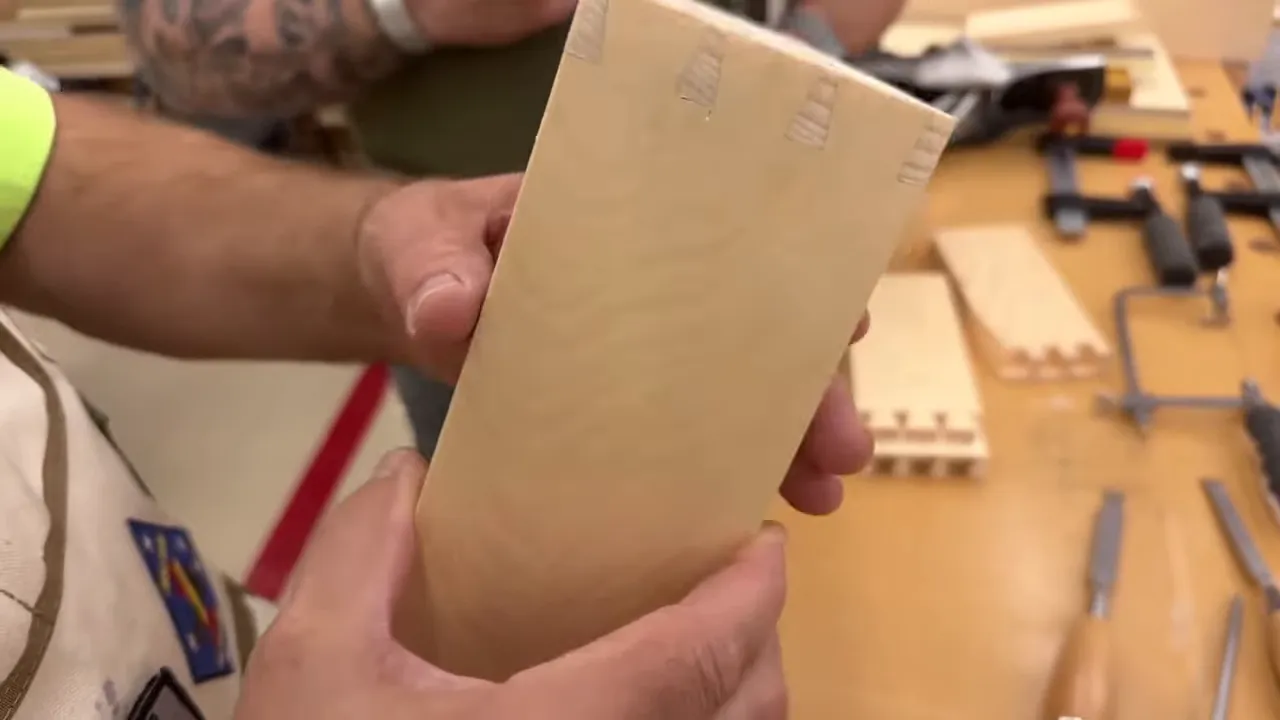
Matt had done construction and household carpentry, but had not worked with hand tools since high school. He quickly discovered that determination and brute force are not the same thing as control. The wood will not always do what you want just because you insist.
He also described the value of getting out of his own head and turning a natural material into something worthwhile, alongside people he appreciated. A retired infantry sergeant major with 22 years of service, including substantial time in the 82nd Airborne Division, Matt came because former student Jay Levy had recommended the experience.
That recommendation is important. A personal conversation with somebody you trust often does more than any explanation I can give.
Martin and Jeremy: Early Attempts Worth Being Proud Of
Martin was taking his first hand-tool class with us. He had completed three through dovetails, and the first one remained his best. His half-blind was his first ever.
He immediately started pointing out a crack. Typical woodworker: hand somebody your work and then give them a guided tour of everything you dislike about it. I would rather a beginner recognize the progress first. There is plenty of time to improve the little faults.
Jeremy, from Chandler, Arizona, was showing his second-ever dovetail. His through joint was impressive, while his other sample still needed some work. Both were useful evidence of somebody learning a new skill rather than simply talking about learning it.
Jeremy works in insurance and wealth management, which prompted a little discussion about corporate sponsorship. Good instruction is important, but we also need funding to keep bringing veterans here. Nothing is getting cheaper.
Chad: A Last-Minute Scholarship Becomes a First Dovetail
Chad's place in the class came about through a particularly generous gesture. A student had to cancel because of a shoulder injury. Daryl Adams, who had attended with his son in July, contacted me and offered to cover the cost if we could find another wounded veteran.
Because the opening was so close to the course, we needed someone local. Chad, a New Brunswick combat-wounded veteran who was already in our system, was able to attend.
He had served 30 years in the Canadian infantry. Although he had done some woodworking, he had never worked with hand tools or understood how to sharpen them. His first through dovetail was the sort of result that supports my claim that a beginner's first joint can rival my own.
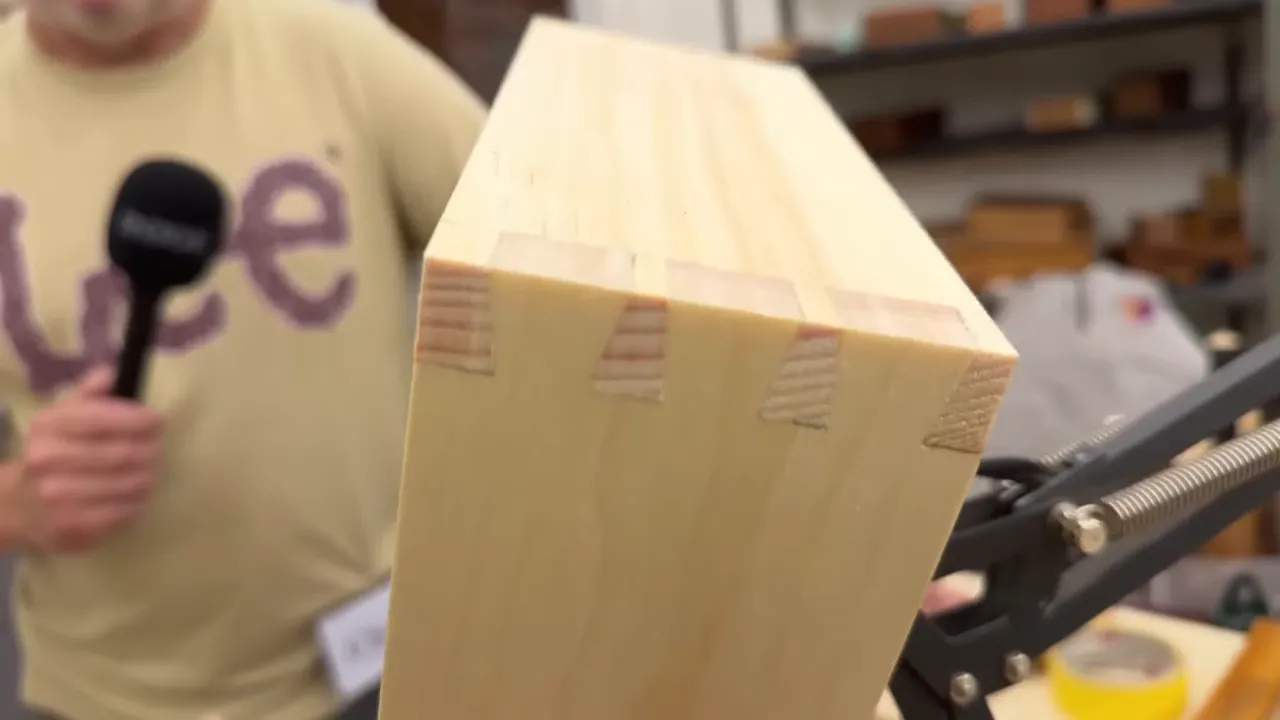
Chad described the course as both humbling and encouraging. He valued the ease of bonding with other veterans, but also the opportunity to connect with civilians. He noticed the supporting people coming through the shop and how much was happening beyond the instruction itself.
That is what Daryl's offer made possible. An empty bench became an opportunity for somebody else.
Sharp Tools, Straight Sawing, and Finesse
There is no getting around the fundamentals. Wayne put his finger on one of the major hurdles: learning to saw a straight line. He also discovered just how satisfying a properly sharpened edge can be.
After sharpening his plane blade, he thought it was better than the blade originally supplied to him. I am perfectly happy with that. The point is for students to become capable of producing their own sharp edges, not dependent on somebody else to do it.
Wayne delighted in getting long, thin ribbons from the plane. That feedback is immediate. You sharpen, you make a cut, and you can see the result.
Why We Use Northern White Pine
We cut these practice joints in northern white pine. People sometimes assume that means we have chosen an easy material. Not necessarily.
Pine requires very sharp tools and careful handling. It dents readily, and careless work shows. That makes it useful for teaching finesse rather than force.
Andy, another New Brunswick wounded veteran, had never used these hand tools, sharpened a blade, or cut dovetails before coming. His first through dovetail and first half-blind were excellent examples of what a complete beginner can achieve with instruction and care.
Paul's work supplied a useful distinction, too. His half-blind had good joint lines, with a small area of chisel blowout. The wood had fractured locally. That is not the same problem as an inaccurately fitted joint.
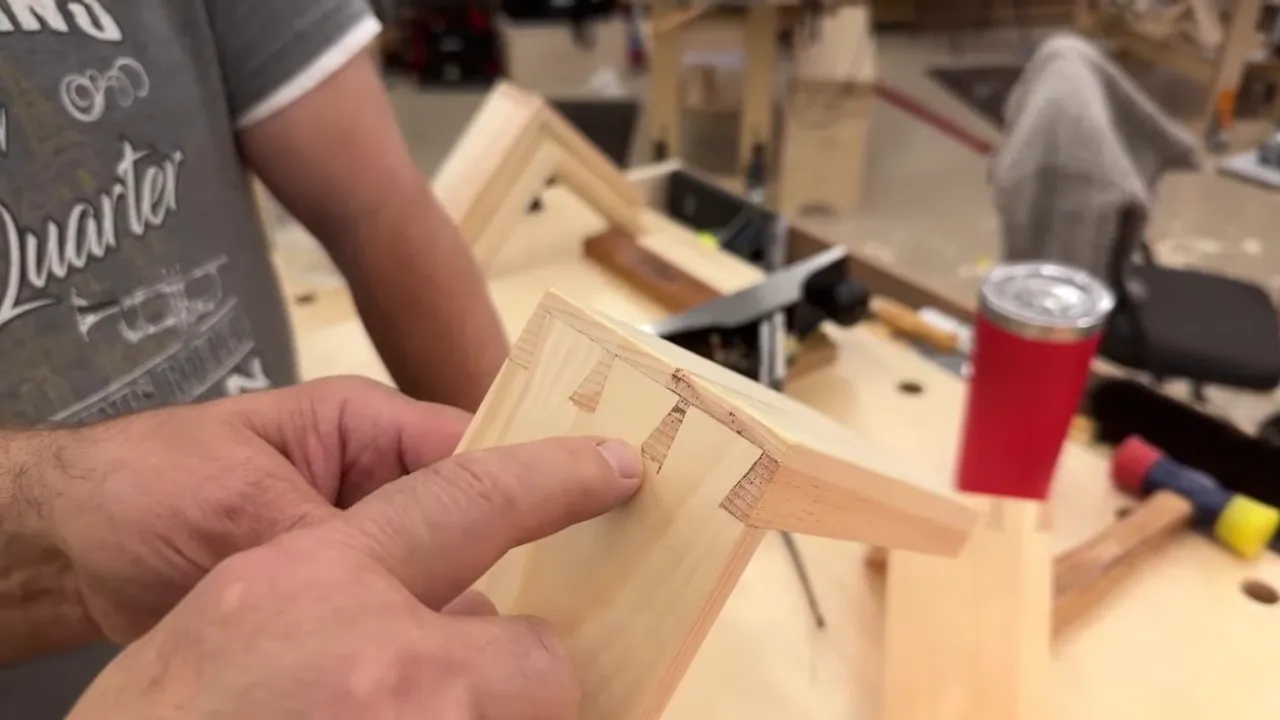
Likewise, when a joint is too tight, forcing it together can damage the surrounding wood. Wayne had a couple of spots that showed that problem. We still had two days to work on it. Progress does not require pretending there is nothing left to learn.
Tool Fit Is Worth Checking
Shane, a 71-year-old retired police officer from Australia, had practiced through dovetails at home but cut both of his first half-blinds here. His work was very good.
We also checked saw-handle fit. He was using a rental kit, and I had him try a larger handle to see whether it suited his hand better. It did, and it turned out to be the size he already had at home.
It was a small exchange, but worth making. Alongside learning the method, it helps to know which tool configuration feels right in your hand.
Different Starting Points, Real Progress
Not everybody comes with the same experience, and that is part of what makes a class interesting. We had complete beginners, people accustomed to construction, technically minded retirees, and students who had already cut quite a few dovetails without formal instruction.
- Ron Kerr, from Columbus, Ohio, had used a dovetail jig before attending. Here he was developing his freehand work and showing his second-ever half-blind. The results were exceptional.
- Scott, Ron's brother-in-law, had retired after a career in the automotive industry. Their first shared woodworking project had been a table for a ceramic outdoor cooker. Hand-cut joinery was new territory, and Scott found that it demanded a different way of thinking from his usual technological approach.
- Paul had tried a little dovetailing independently but wanted hands-on instruction, particularly with the offset method and the tools he had seen demonstrated. He was excited to have joints coming together successfully.
- Ken, from Clinton, Michigan, had never used hand tools of this nature or cut a dovetail. Woodworking for Warriors in Tipton, Michigan, and Craig helped connect him with the program. His first joint showed what determination and instruction can accomplish.
- James, from Washington, had served 12 years as an Army Special Forces medic. He had cut quite a few dovetails independently. His through dovetail here was spot on, and his half-blind work was progressing well, too.
- Brent, from Edmonton, Alberta, had practiced a handful of joints in half-inch plywood. His first half-blind here was exceptional. He had originally connected with us after receiving a dovetail saw as a Christmas gift and having a conversation about what else he needed to succeed.
- John, our left-handed student, had construction experience but no hand-tool woodworking background. His brother had encouraged him to attend. By his third dovetail, he was doing work he could be proud of, and naturally claimed to be better than his brother.
Shane had initially been skeptical of my claim that concentrated instruction could advance someone's hand skills by the equivalent of years of working things out independently. After four days, he felt the methods and process had justified the trip from Australia.
These are not identical journeys, and a good course should not require them to be. What matters is that each person leaves more capable than when they arrived.
The Camaraderie Goes Both Ways
Again and again, civilian students said they had come for the woodworking and found something they had not anticipated.
Martin spoke about new friendships and a much greater appreciation for military service. Jeremy felt similarly. Ron said he had expected to learn about hand tools, not to learn so much about courage, dedication, and service.
Shane came from policing rather than the military. Listening to experiences that veterans chose to share gave him a deeper understanding of injuries that are not necessarily visible. Scott and Brent also described those conversations as one of the most important parts of their week.
For veterans, being among other veterans mattered. But so did working alongside civilians on the same difficult little joints, asking the same questions, and sharing the same meals.
Adam thanked the friend who had recommended him and described this as the most helpful experience for his mental health among several programs he had attended. That was his personal experience, and I am grateful he felt comfortable sharing it.
John described finding purpose and an outlet. Chad talked about communication becoming easier. Those are different expressions of why we do this work.
Wayne's Journey From Hilo
Wayne, a Vietnam veteran from Hilo, Hawaii, was approaching his 81st birthday. He had been making ukuleles for several years, but had never cut dovetails.
He learned about the Purple Heart Project after attending a local Walk with a Doc gathering. Luther approached him afterward, explained the program, and encouraged him to apply.
Wayne assumed his chances of being selected were slim. Then the phone call came, and here he was, learning to sharpen chisels and plane blades and steadily improving his joinery.
His story is a good reminder not to decide on our behalf that you are unlikely to be selected.
The People Behind the Benches
A workshop like this takes far more than an instructor standing at the front of a room.
Chris Davenport, our go-to person for product development and engineering, was with us. Moose arrived with gifts for the scholarship veterans. Ken helped distribute Purple Heart Project shirts to the nonscholarship participants. Angie and her sister Lynn handle the careful packaging of those shirts, right down to the card and little seal of approval.
Then there is the kitchen. I do not think a single person missed an opportunity to mention the food. The advice ranged from leaving your packed lunch at home to not arriving in the middle of a diet.
My wife and the kitchen team, including Anita, Donna, and Chloe, put a tremendous amount into looking after everybody. The students noticed the meals, of course, but they also noticed the welcome. John objected to speaking of everybody simply as staff. To him, the place felt like family.
We even stopped work to celebrate Luther's 76th birthday from across the distance to Hawaii, complete with candles, treats, singing, and the usual amount of good-natured harassment. Luther had helped Wayne find his way here. It seemed only right that the whole room should help mark his day.
Returning to Help the Next Class
Jeff returned after attending the previous year and found assisting even more enjoyable than taking the course. Walking around, helping with problems, and listening to another group's stories gave him a different perspective.
He had been open about his own difficulties when he first attended. That openness helped other people feel they could speak, too. Coming back, he also saw much more of the work happening behind the scenes.
Kyle helped us through the week as well, despite all the jokes about how little he was doing. We had a great team. The teasing is part of the atmosphere, but the appreciation is genuine.
Finding the Next Veteran Who Needs This
At nearly every bench, I asked some version of the same question: who do you know who should be here?
We rely heavily on former participants to identify the next group. We call a trusted recommendation a blue chip. Those recommendations carry significant weight in selection, although they are not a promise of a place.
Matt came through Jay. Chad followed a friend's experience closely before attending. James had a buddy encouraging him for a year or two. Ken came through a woodworking community. John came because of his brother.
By Thursday, they were thinking about friends they could encourage in turn.
The question is not whether that friend owns a saw. It is whether you know a combat-wounded veteran who is struggling and might benefit from a new outlet and a supportive group. The application is online, and a conversation with someone who has attended can make that first step less intimidating.
Keeping the Opportunity Available
All of this depends on support. For the year discussed at this class, the budget was approximately US$400,000 to bring 43 combat-wounded veterans through the program.
Daryl's sponsorship of Chad was one example of what individual generosity can accomplish. We also acknowledged a charitable foundation that had given $10,000 in each of two consecutive years.
Former student Tim was fundraising through the Maryland Ironman, with a $15,000 goal that he had already exceeded by the time of our Thursday gathering.
Marc and Nicole Spagnuolo of The Wood Whisperer were supporting the Purple Heart Project through their Woodworkers for a Cause online auction, scheduled from September 1 through October 3. We had donated items, and other contributors had supplied plenty of worthwhile auction lots.
Those efforts, along with everyday donations and the volunteers building and delivering benches, keep the opportunity available.
As pleased as I was with class 44's dovetails, the real objective goes further. James had reached the point where I could barely fault his through joint. That brings to mind the challenge Ian Kirby would put to a student: once you can cut the joint, what are you going to make with it? We planned to build on that question with design material in the following months.
That is where we want this to lead: skills that become useful work, equipment that gets used at home, and friendships that last beyond six days in the shop.
Help us keep it going, and help us find the people who need it most. There are veterans who have never considered woodworking and may discover something valuable at a bench.
|